How to Get Harder Erections and Improve Erection Quality
14 min read
A harder erection depends on more than sexual desire. Normal erectile function requires the brain, nerves, hormones and blood vessels to work together while enough blood enters the erectile tissue and blood leaving the penis is temporarily restricted. That means the best ways to improve erection quality are usually not mysterious erection hacks. They involve improving the factors that affect blood flow and arousal, removing the things that interfere with erections, and treating an underlying medical problem when one exists. This guide focuses specifically on erection firmness and overall erection quality.

Quick answer
- Prioritise cardiovascular health: regular aerobic exercise, healthy blood pressure, healthy blood sugar and not smoking all support erectile function.
- Give yourself enough time and stimulation to become fully aroused instead of treating an erection as an instant on/off switch.
- Reduce excessive alcohol, especially before sex.
- Address stress and sexual performance anxiety if erection quality mainly changes in sexual situations.
- Review medications and health conditions with a clinician if erection quality has noticeably declined.
- Prescription ED medication can substantially improve firmness for appropriate patients, but belongs under medical guidance.
- Persistent weaker erections deserve medical attention — erectile problems can be an early marker of cardiovascular or metabolic disease.
Erection firmness improves mostly through blood-vessel health, real arousal, and removing whatever is working against you — not through a supplement. Free Kegel Trainer for Men.
What makes an erection hard?
The penis contains two main erectile chambers called the corpora cavernosa. During sexual arousal, nerve signals cause smooth muscle in and around these tissues to relax. Arterial blood flow increases, the erectile spaces fill, and the expanding tissue compresses the veins that would otherwise drain blood away. Increased inflow plus reduced outflow is what produces rigidity.
Erection quality can therefore be affected by several different systems at once — which is why firmness can change even when nothing is structurally wrong with the penis.
| Factor | Why it matters |
|---|---|
| Arterial blood flow | Supplies blood to the erectile tissue |
| Healthy blood vessels | Allow arteries to dilate properly |
| Nerve signalling | Starts and coordinates the erectile response |
| Sexual arousal | Drives erectile signalling from the brain |
| Veno-occlusion | Helps keep blood inside the erectile chambers |
| Hormonal health | Testosterone can affect libido and erectile physiology |
| Psychological state | Stress and anxiety can interfere with arousal |
1. Improve your aerobic fitness
Regular aerobic exercise has some of the strongest non-drug evidence for improving erectile function. A 2023 systematic review and meta-analysis of 11 randomised controlled trials found that aerobic exercise improved erectile-function scores compared with non-exercising controls, and the improvement was larger in men who started with more significant difficulties.
This does not mean one workout produces a stronger erection tonight. Exercise is a long-term erectile-health intervention, and it matters most when cardiovascular risk factors are part of the problem.
Practical options
- Brisk walking
- Cycling
- Jogging
- Swimming
- Rowing
- Any other sustained cardiovascular exercise
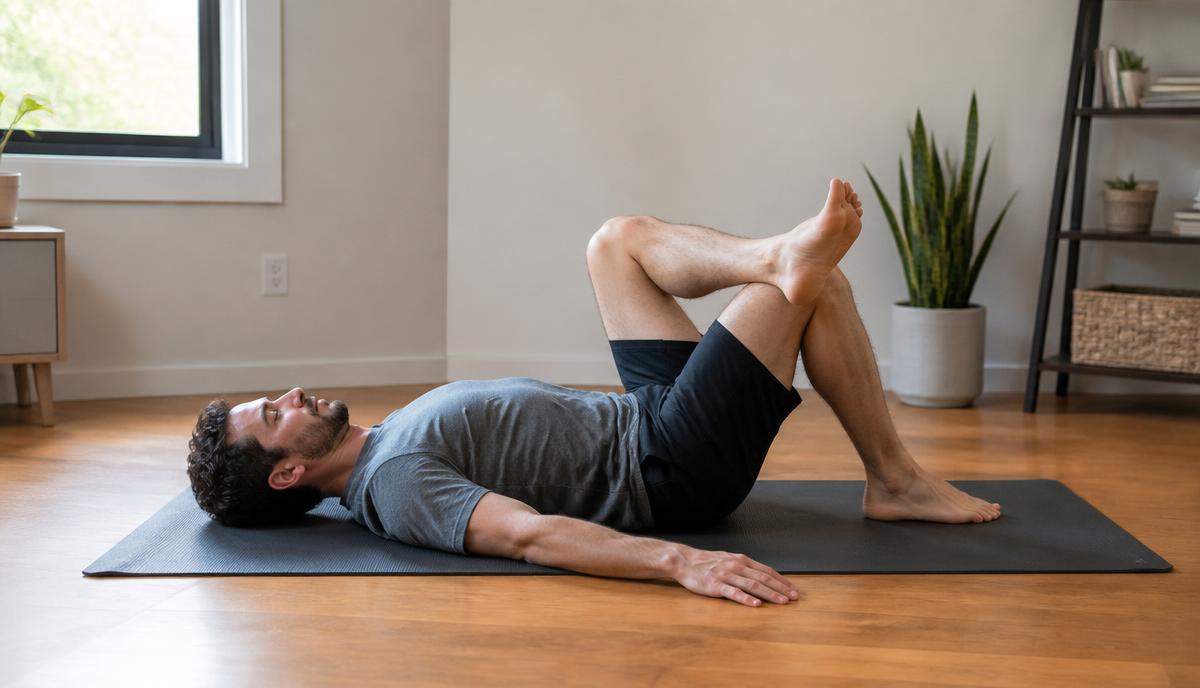
Hip mobility and pelvic floor relaxation work can also help, particularly if your pelvic floor is chronically tense. Relaxation matters as much as strength here.
Mobility and pelvic floor routine
None of these are a cure for erectile dysfunction, but they help you release a tight pelvic floor, breathe better and gain control over muscles most men never consciously use.
| Exercise | How to do it | What to focus on |
|---|---|---|
| Happy Baby Pose | Lie on your back, bring your knees toward your chest and hold the outside of your feet or legs. Let the knees move gently toward your armpits. Hold 30–60 seconds. | Relax your stomach, inner thighs and pelvic floor. Breathe slowly and never force the stretch. |
| Butterfly Stretch | Sit with the soles of your feet together, let your knees fall outward, hold your feet and lean gently forward. Hold 30–60 seconds. | Keep your back relaxed and avoid pushing your knees down aggressively. |
| Butterfly Flaps | From the butterfly position, move your knees gently up and down in a controlled motion. | Keep the movement small and relaxed — mobility work, not an intense stretch. |
| Deep Squat Hold | Feet slightly wider than shoulder-width, lower into a comfortable deep squat. Hold 20–60 seconds. | Breathe deeply and let the pelvic floor relax. Do not strain or hold your breath. |
| Child's Pose | Kneel, sit your hips toward your heels and reach your arms forward while lowering your chest. | Take slow belly breaths and consciously relax the muscles around the pelvis. |
| Diaphragmatic Breathing | Lie on your back with one hand on your stomach. Breathe slowly through your nose so the abdomen expands, then exhale gently. | Let the pelvic floor relax on each inhalation rather than constantly tightening it. |
| Reverse Kegel | Instead of squeezing, gently relax and lengthen the pelvic floor as you inhale — softly releasing the muscles used to stop urine or gas. | Do not push or bear down hard. The goal is relaxation, not straining. |
| Slow Kegels | Gently contract the pelvic floor, hold 3–5 seconds, then fully relax for at least as long. Repeat 8–10 times. | Use only the pelvic floor. Avoid squeezing abs, buttocks or thighs. Full relaxation between reps matters. |
| Quick Kegels | Contract for about one second, then release completely. Repeat 5–10 times. | Keep each contraction controlled. More repetitions are not necessarily better. |
| Glute Bridge | Lie on your back, knees bent, feet flat. Push through your feet, lift your hips, lower slowly. 10–15 reps. | Use your glutes rather than over-squeezing the pelvic floor. Keep breathing normally. |
| Hip Flexor Stretch | Kneel on one knee with the opposite foot in front. Move your hips forward until you feel a stretch at the front of the rear hip. | Keep the pelvis controlled rather than arching the lower back. |
| Adductor Rock-Back | On hands and knees, extend one leg out to the side and slowly rock your hips backward and forward. | You should feel a gentle inner-thigh stretch. Keep it slow and pain-free. |
| Cat-Cow | On hands and knees, slowly alternate between rounding and gently arching your back while breathing. | Coordinate movement with slow breathing and avoid aggressively contracting the pelvic floor. |
2. Stop smoking
Smoking damages cardiovascular health and is strongly associated with erectile dysfunction. Healthy erectile tissue relies on functional blood vessels and nitric-oxide signalling, and tobacco use contributes to vascular disease and impaired penile blood flow.
If you smoke, quitting is one of the most meaningful changes you can make for both cardiovascular and erectile health.
3. Improve blood pressure, cholesterol and blood sugar
The same vascular problems that reduce blood flow to the heart can also affect the arteries supplying the penis.
Conditions commonly associated with erectile dysfunction
- Hypertension
- High cholesterol
- Atherosclerosis
- Diabetes
- Obesity
- Metabolic syndrome
This connection matters because erection quality can deteriorate before obvious cardiovascular symptoms appear. Current cardiovascular and sexual-medicine consensus treats ED as an important cardiovascular risk marker.
If your erections have become consistently weaker without an obvious explanation, checking cardiovascular risk factors is more useful than searching for a supplement.
4. Be patient with arousal
An erection does not exist independently of arousal. It involves signalling from the brain and autonomic nervous system, not simply mechanical blood flow.
In practice, erection quality often improves when you
- Allow more time for foreplay
- Use the type of stimulation you actually find arousing
- Avoid rushing to penetration
- Continue stimulation while changing activities or positions
- Talk with your partner about what feels good
Needing stronger or more direct stimulation with age does not automatically mean something is medically wrong — erections can simply take longer to develop as men get older.
5. Reduce sexual performance anxiety
A single weaker erection can create a frustrating feedback loop:
- You notice the erection is not completely hard.
- You start monitoring it.
- Attention shifts from pleasure to performance.
- Anxiety increases.
- Arousal decreases.
- The erection becomes weaker.
Psychological and emotional factors such as stress and anxiety can cause or worsen erectile problems.
When erection quality is good during masturbation or with spontaneous erections but inconsistent with a partner, situational psychological factors become particularly relevant — although that does not prove the problem is exclusively psychological.
6. Limit excessive alcohol
A small amount of alcohol does not necessarily cause erection problems, but heavier drinking can interfere with sexual function. NIDDK lists excessive alcohol use among the lifestyle factors that contribute to erectile problems and recommends limiting it as part of prevention and management.
If erections are consistently softer after drinking, the simplest experiment is to compare sexual function with little or no alcohol.
7. Work toward a cardiovascular-healthy diet and weight
There is no single food proven to produce an immediate harder erection. The better-supported approach is improving overall metabolic and cardiovascular health.
Randomised studies and systematic reviews suggest that lifestyle interventions targeting cardiovascular risk factors can improve erectile function in men with ED. Mediterranean-style dietary patterns have shown potentially favourable effects in men with metabolic disease, although diet is a long-term strategy rather than an acute erection treatment.
Foods that support heart and blood-vessel health are generally the same foods most likely to support erectile health over time.
Foods that may support better blood flow
| Food | Why it may be helpful | What to keep in mind |
|---|---|---|
| Leafy greens | Spinach, arugula and similar vegetables contain dietary nitrates the body can use to support nitric oxide production and blood-vessel dilation. | Supportive for vascular health, but not a direct treatment for erectile dysfunction. |
| Beets | Rich in dietary nitrates and may support nitric oxide availability and healthy blood flow. | Evidence for blood-vessel benefits is stronger than evidence for improving erections. |
| Berries | Blueberries, strawberries and others contain flavonoids and antioxidants linked with cardiovascular health. | Observational studies link higher flavonoid intake with better erectile health — that is not proof of cause. |
| Citrus fruits | Oranges, grapefruit and others contain flavanones and vitamin C, both associated with vascular health. | Part of a heart-healthy diet rather than an erection-enhancing food. |
| Pomegranate | Contains polyphenols that may support endothelial and blood-vessel function. | Research on erectile function is limited. Claims of a natural ED treatment are exaggerated. |
| Watermelon | Contains citrulline, an amino acid involved in the nitric-oxide pathway. | Normal servings provide far less than doses studied in citrulline supplements. |
| Walnuts and other nuts | Provide unsaturated fats, minerals and plant compounds that support cardiovascular health. | Calorie-dense, so portion size matters if weight management is a goal. |
| Extra-virgin olive oil | A cornerstone of the Mediterranean diet and a source of unsaturated fats and polyphenols. | Benefits relate to overall cardiovascular health, not an immediate erection effect. |
| Fatty fish | Salmon, sardines, mackerel and trout provide omega-3 fats and protein. | Part of an overall healthy diet rather than a testosterone or erection booster. |
| Avocado | Unsaturated fats, potassium and fibre that support cardiovascular health. | Healthy, but not uniquely beneficial compared with other sources of unsaturated fat. |
| Beans and lentils | Fibre, plant protein and minerals that support healthy blood sugar and cholesterol. | Benefit works through long-term metabolic and cardiovascular health. |
| Whole grains | Oats, barley and other whole grains provide fibre and support healthier cholesterol and blood sugar. | Choose minimally processed grains rather than assuming all bread and cereal are equivalent. |
| Tomatoes | Rich in lycopene and other antioxidants associated with cardiovascular health. | No strong evidence that tomatoes directly improve erectile function. |
| Dark chocolate / cocoa | Cocoa flavanols may support endothelial function and nitric-oxide signalling. | Choose high-cocoa, lower-sugar products. Chocolate is not an ED treatment. |
| Pumpkin seeds | Magnesium, zinc and unsaturated fats that contribute to normal physiological function. | Correcting a deficiency matters far more than megadosing single minerals. |
| Fruit in general | Fibre, potassium, vitamins and polyphenols, part of dietary patterns linked to better cardiovascular health. | There is no single best fruit for erections. Variety beats chasing a superfood. |
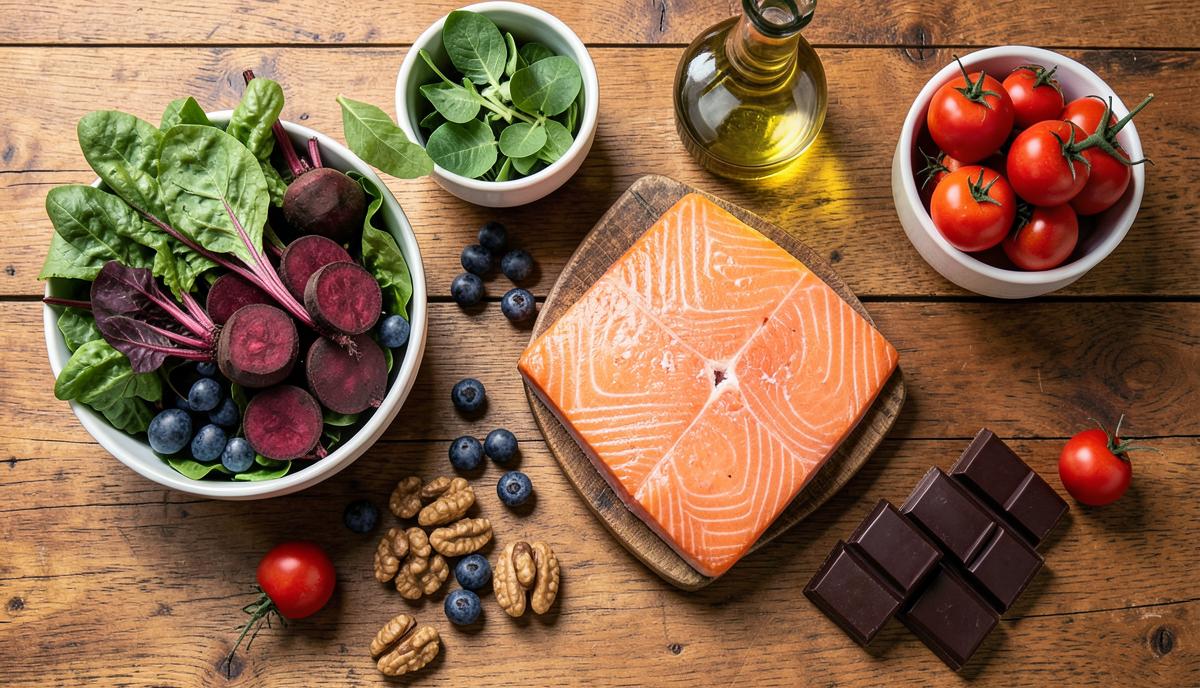
It is just as useful to look at what dominates your diet. Habitual patterns matter; a single meal does not.
Foods and habits to limit
| Food or habit | Why limiting it may help | What to keep in mind |
|---|---|---|
| Highly processed meats | Diets high in processed meat are associated with poorer cardiovascular health, which also matters for erectile function. | You do not need to eliminate red meat; overall pattern and quantity matter. |
| Sugary drinks | Regular high intake contributes to excess calories, weight gain and poorer metabolic health. | One soda will not impair your erections. Long-term patterns matter. |
| Large amounts of refined carbohydrates | Diets dominated by pastries, sweets and refined grains make blood-sugar and weight control harder. | Carbohydrates are not the enemy — whole grains, potatoes, fruit and legumes all fit. |
| Excess calories | Long-term calorie excess drives obesity, insulin resistance and cardiovascular risk factors linked with ED. | If you are already lean and active, aggressive restriction is not beneficial either. |
| Trans fats and heavily fried foods | Diets high in poor-quality fats are associated with worse cardiovascular health. | An occasional fried meal is unlikely to matter; habitual diet is what counts. |
8. Review medications that may affect erections
Some prescription and over-the-counter medications can contribute to erectile problems.
- Certain antidepressants
- Some blood-pressure medications
- Sedatives
- Antihistamines
- Some pain medications
- Certain hormone treatments
Do not stop prescribed medication on your own. Ask the prescribing clinician whether sexual side effects are possible and whether a safe alternative exists.
9. Treat low testosterone only when it is actually present
Testosterone gets blamed for far more erection problems than it should. Low testosterone can contribute to sexual symptoms in some men, particularly reduced libido, and it sits among the possible medical causes of erectile dysfunction.
But weaker erections do not automatically mean low testosterone. Testing is more useful than guessing — see our guide to increasing testosterone naturally for what actually moves the needle.
10. Consider evidence-based ED medication when appropriate
Phosphodiesterase type 5 inhibitors (PDE5 inhibitors) increase penile blood flow and are established treatments for erectile dysfunction. The European Association of Urology recommends them as first-line medical therapy, and NIDDK explains that these medications help men get and maintain erections. Common examples include sildenafil and tadalafil.
They are not simply sex boosters. They enhance the physiological erectile response and generally still require sexual stimulation.
They are also not appropriate for everyone. PDE5 inhibitors must not be combined with nitrate medications, because the combination can cause dangerous drops in blood pressure. Discuss suitability with a healthcare professional.
How to improve erection quality before sex
For a single encounter, the realistic strategy is removing the short-term factors that commonly work against an erection.
- Avoid getting heavily intoxicated. (Alcohol occasionally masks anxiety, but it is not a strategy.)
- Give yourself adequate time for arousal.
- Use continuous pleasurable stimulation instead of repeatedly checking firmness.
- Reduce the pressure to penetrate immediately.
- Communicate about stimulation rather than hiding erection changes.
- If you have prescribed ED medication, use it exactly as directed.
These steps will not overcome significant vascular or neurological ED, but they do prevent unnecessary situational erection problems.
What doesn't reliably work
Be particularly cautious with products promising instant erections or natural Viagra. The FDA continues to identify sexual-enhancement products containing undeclared sildenafil, tadalafil and other drug ingredients, which can create serious interactions — especially with nitrates. The words natural, herbal and supplement do not guarantee safety.
Male enhancement supplements
One magic erection food. A heart-healthy dietary pattern may support erectile health over time. That is very different from claiming one fruit, spice or drink creates a harder erection tonight.
Raising testosterone without a diagnosis. Testosterone therapy is not a general erection enhancer for men with normal levels; hormonal treatment should target an actual hormonal problem.
When to see a healthcare professional
Seek medical evaluation if
- Erection quality has clearly deteriorated and stays worse
- You frequently cannot become firm enough for sex
- You also struggle to maintain erections
- You have diabetes, hypertension, high cholesterol or cardiovascular disease
- You have markedly reduced libido or other possible hormonal symptoms
- You have penile pain, a new curve or a penile lump
- The problem followed pelvic surgery or injury
- Erection changes are causing significant distress
Persistent erectile problems can be an early clue to cardiovascular disease, so they should not be dismissed as a sex-only problem.
Frequently asked questions
How can I make my erection harder naturally?
The best-supported non-drug approach is improving cardiovascular and metabolic health: regular aerobic exercise, stopping smoking, healthy weight management and appropriate treatment of blood pressure, cholesterol and diabetes.
Can exercise make erections harder?
Evidence from randomised controlled trials indicates that regular aerobic exercise can improve erectile-function scores, particularly in men with existing erectile difficulties.
Why is my erection only 80% hard?
Temporary variation can come from arousal, anxiety, alcohol, fatigue, medication and many other factors. Persistent reductions can also reflect vascular, neurological, hormonal or mixed erectile dysfunction.
Does better blood flow mean harder erections?
Adequate arterial inflow is essential, but hardness also depends on nerve signalling, arousal, smooth-muscle relaxation and restricting venous outflow.
Are weaker erections always erectile dysfunction?
No. Occasional erection difficulty is common. ED generally refers to persistent difficulty achieving or maintaining an erection sufficient for satisfactory sexual activity.
Train the muscle behind control
The Free Kegel Trainer guides you through squeeze and release intervals, day by day.
Start Day 1Sources
- Aerobic exercise and erectile function — 2023 systematic review and meta-analysis of randomised controlled trials
- NIDDK — Erectile Dysfunction: Symptoms, Causes, Treatment and Prevention
- European Association of Urology — Guidelines on Sexual and Reproductive Health
- Mayo Clinic — Erectile dysfunction
- Gupta et al. — The effect of lifestyle modification and cardiovascular risk factor reduction on erectile dysfunction: systematic review and meta-analysis
- Esposito et al. — Mediterranean diet improves erectile function in men with metabolic syndrome
- U.S. Food and Drug Administration — Tainted Sexual Enhancement Products
More Sexual Health articles
Medical disclaimer: This article is educational and not medical advice. Speak to a doctor or pelvic floor physiotherapist about persistent pelvic pain or urinary symptoms.