Morning Wood: What Morning Erections Actually Mean
8 min read
Morning erections, commonly called “morning wood”, are usually part of a normal physiological phenomenon known as sleep-related erections or nocturnal penile tumescence (NPT). Erections can occur several times during sleep, particularly during rapid eye movement (REM) sleep. You notice a “morning erection” simply when you wake while one of these sleep-related erections is still present. They can provide interesting information about erectile physiology, but they are frequently overinterpreted. Missing a morning erection does not automatically mean low testosterone, erectile dysfunction or poor penile blood flow. This article explains what morning erections actually mean — and what they do not.

Quick answer
- A morning erection is usually the last sleep-related erection that happens to still be present when you wake.
- Sleep-related erections occur particularly during REM sleep and are not necessarily caused by sexual dreams or a full bladder.
- You do not need to wake with an erection every morning to be healthy.
- Morning erections can provide useful information about erectile function, but their presence or absence cannot diagnose the cause of erection problems by itself.
- A persistent change in morning erections can be worth discussing with a healthcare professional when it occurs together with worsening erections while awake.
- Morning erections are influenced by more than testosterone, so they should not be used as a home testosterone test.
A morning erection is usually just a normal sleep-related erection you happened to wake up during — missing one now and then is not a diagnosis. Free Kegel Trainer for Men.
What is morning wood?
Morning wood is an erection noticed immediately after waking.
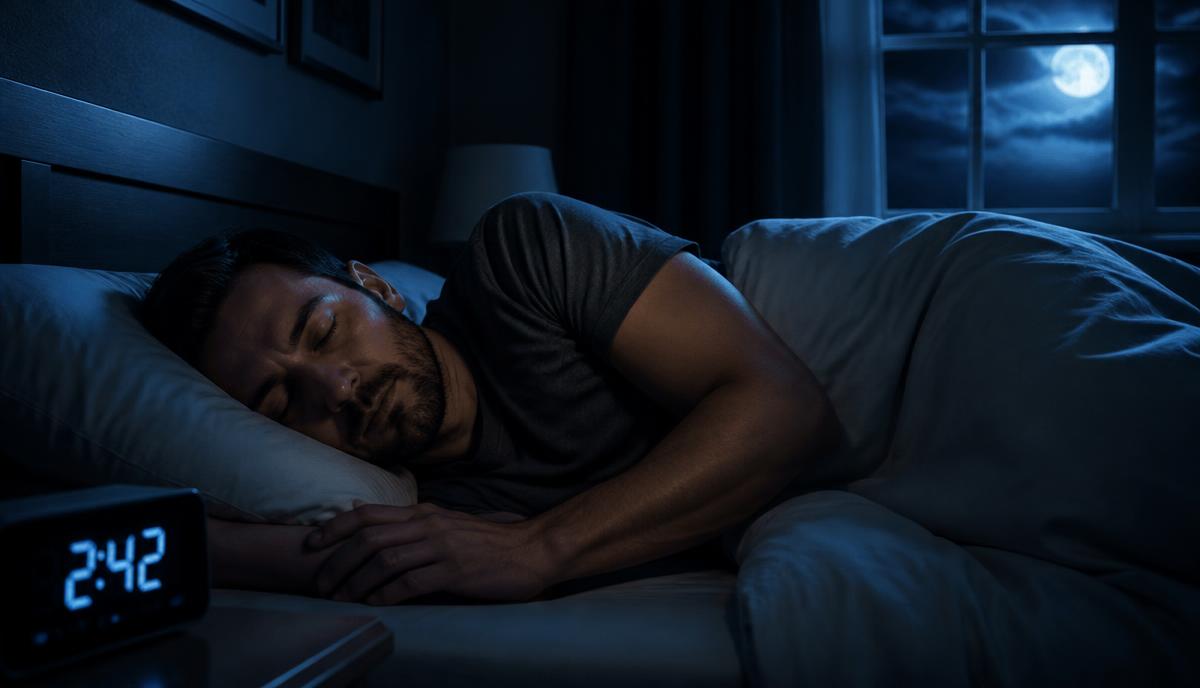
The medical phenomenon is broader than that. Men can experience multiple spontaneous erections throughout sleep without being aware of them. Research has linked sleep-related erections especially closely to REM sleep.
So the erection you see at 7 a.m. may simply be the one that happened to coincide with waking. That is why morning erections are not necessarily a once-per-day event that begins in the morning.
Why do men get erections during sleep?
The complete purpose and neurological control of sleep-related erections are not fully understood. They appear to involve changes in nervous-system activity during sleep, particularly during REM sleep.
Normal erectile physiology still applies: nerve signaling leads to smooth-muscle relaxation, increased blood flow into the corpora cavernosa and restriction of venous outflow.
Sleep-related erections happen automatically and do not require conscious sexual stimulation.
Does morning wood mean you had a sexual dream?
Not necessarily. REM sleep is also the sleep stage strongly associated with vivid dreaming, which may explain why the two sometimes occur together.
But the erection itself is a physiological sleep phenomenon. You can have a sleep-related erection without remembering any erotic dream.
Does a full bladder cause morning erections?
This is a popular explanation, but it is too simplistic. You may frequently have both a full bladder and an erection when you wake simply because both occur after several hours of sleep.
The strong association between sleep-related erections and REM sleep is much better established than the idea that bladder fullness is their primary cause.
Is it normal not to have a morning erection every day?
Yes. You only notice a sleep-related erection if:
- one happens near the time you wake, and
- it lasts long enough for you to notice.
Sleep timing, REM sleep, awakening patterns and other factors can therefore determine whether you see one.
Not remembering morning erections every day is not by itself a diagnosis of ED. The more useful question is whether there has been a sustained change combined with changes in erections while awake.
What do morning erections say about erectile function?
The presence of normal sleep-related erections shows that the erectile system can produce an involuntary erection under at least some circumstances.
Historically, nocturnal penile tumescence testing has therefore been used as part of the evaluation of erectile dysfunction. NIDDK notes that a nocturnal erection test may help clinicians investigate whether ED has a physical component.
However, the interpretation is not as simple as morning erections = psychological ED and no morning erections = physical ED. Most erectile dysfunction is better understood as potentially involving organic, psychological or mixed factors.
Morning erections and performance anxiety
Suppose you consistently have strong erections:
- during sleep
- in the morning
- during masturbation
…but repeatedly lose erections in a specific partnered situation. That pattern can make situational factors such as performance anxiety more relevant.
The Princeton IV consensus notes that situational ED in the presence of morning or masturbatory erections is often considered largely psychogenic. But psychological and physical factors can overlap, so the pattern does not prove a diagnosis.
Morning erections and testosterone
Testosterone is involved in male sexual physiology, and research indicates that androgens influence sleep-related erections.
But morning erections are not a reliable at-home testosterone test. You cannot conclude: “I missed morning wood this week, therefore my testosterone is low.”
Low testosterone is diagnosed through symptoms, clinical assessment and appropriately timed blood testing — not by counting morning erections. If libido, energy or other possible hormonal symptoms have also changed, that is a better reason to investigate.
Do morning erections become less common with age?
Sleep architecture and erectile physiology can change with age and health. However, sleep-related erections can continue well into later life, and older age alone does not mean erections should disappear completely.
More importantly, aging increases exposure to conditions that can influence erections, including:
- hypertension
- cardiovascular disease
- diabetes
- medication use
- sleep disorders
So a change in erectile function should not automatically be written off as “just aging.”
Can poor sleep affect morning erections?
Yes, potentially. Because sleep-related erections are closely connected to sleep architecture and REM sleep, disrupted sleep can affect their measurement and occurrence.
Research on nocturnal penile tumescence has shown that sleep disorders can disrupt normal NPT patterns and potentially produce misleading results during testing.
That means a period of poor or fragmented sleep may change how often you notice morning erections without necessarily indicating a primary penile problem.
What if my morning erections suddenly disappear?
One or several mornings without an erection usually do not mean much. A more important pattern is a sustained reduction accompanied by:
- weaker erections during masturbation
- difficulty becoming fully hard during sex
- repeated loss of erections
- reduced sexual desire
- new cardiovascular or metabolic symptoms
- a recent medication change
Persistent erectile changes deserve clinical evaluation because vascular, neurological, hormonal, medication-related and psychological factors can all contribute.
Can doctors measure nighttime erections?
Yes. Nocturnal penile tumescence and rigidity testing can measure erections during sleep. Modern devices may track factors such as:
- penile circumference
- rigidity
- duration
- number of erectile events
The technique can provide diagnostic information in selected cases, although it is not required for every man with erectile problems. Most ED evaluation begins with medical, sexual and psychological history, physical examination and appropriate laboratory testing.
Morning erections vs erections during sex
These erections share the same basic penile vascular machinery but arise in different contexts.
| Morning/sleep erection | Sexually stimulated erection |
|---|---|
| Occurs unconsciously during sleep | Triggered by sexual arousal |
| Strongly associated with REM sleep | Triggered by erotic/tactile stimulation |
| Does not require a partner | Depends on awake sexual signaling |
| Can provide diagnostic clues | Directly reflects sexual function in context |
| Not controlled voluntarily | Influenced by arousal, anxiety and environment |
This distinction explains why a man can have good morning erections but inconsistent erections during partnered sex.
When to see a healthcare professional
Consider discussing the issue with a healthcare professional if:
- morning erections have largely disappeared over a sustained period and other erections have also weakened
- you repeatedly cannot get or maintain an erection sufficient for sex
- libido has markedly declined
- you have diabetes or cardiovascular risk factors
- symptoms began after medication changes
- you have penile pain, curvature or injury

Do not use morning erections alone to diagnose ED or low testosterone.
Frequently asked questions
How often should men get morning erections?
There is no clinically required number of mornings per week. Sleep-related erections can occur without being noticed, so counting only erections present at waking gives an incomplete picture.
Does morning wood mean your testosterone is high?
No. Testosterone influences sleep-related erectile physiology, but the presence of morning erections does not tell you that your testosterone level is “high.”
Does no morning wood mean low testosterone?
No. Many factors affect whether you notice an erection when waking. Persistent loss alongside other hormonal or sexual symptoms may justify evaluation.
Can you have ED and still get morning erections?
Yes. Erectile dysfunction can be situational or mixed, and normal nocturnal erections do not completely exclude ED.
Why do I have morning erections but lose erections during sex?
Situational anxiety, differences in stimulation and other psychological factors may contribute. The pattern can be informative, but it does not prove that there is no physical component.
Train the muscle behind control
The Free Kegel Trainer guides you through squeeze and release intervals, day by day.
Start Day 1Sources
- Cleveland Clinic — Why do men get morning erections?
- PubMed — Sleep-related erections: neural mechanisms and clinical significance
- PubMed — Testosterone and sleep-related erections
- NIDDK — Diagnosis of erectile dysfunction
- PubMed — Nocturnal penile tumescence devices: past, present and future
- PubMed — Role of NPTR monitoring in psychogenic ED
- EAU — Management of erectile dysfunction
- Princeton IV Consensus Guidelines
More Sexual Health articles
Medical disclaimer: This article is educational and not medical advice. Speak to a doctor or pelvic floor physiotherapist about persistent pelvic pain or urinary symptoms.