Tight vs Weak Pelvic Floor in Men: How to Tell the Difference
7 min read
Should you strengthen your pelvic floor or relax it? That question matters because the two approaches target different problems. Men with urinary leakage after prostate surgery may benefit from structured pelvic-floor strengthening. Men with pelvic-floor overactivity and chronic pelvic pain may instead need relaxation, coordination and myofascial treatment. Unfortunately, the distinction is not always obvious. This article shows what usually separates weakness from excessive tension, why the two can coexist and when professional assessment is preferable to guessing.
Quick answer
- Weak pelvic floor: difficulty generating or maintaining enough useful contraction.
- Tight pelvic floor: excessive resting tension or difficulty relaxing and lengthening.
- A pelvic floor can be both tight and functionally weak at the same time.
- Leakage under pressure usually points more toward weakness; pain and difficulty relaxing point more toward tightness.
- Kegels help some weakness-related problems but can aggravate overactive pelvic-floor symptoms.
- Persistent or worsening symptoms deserve assessment by a pelvic-health professional.
Weakness means difficulty generating useful contraction; tightness means excessive resting tension or difficulty relaxing. Symptoms overlap, so use this as a guide, not a diagnosis. Free Kegel Trainer for Men.
Tight vs Weak Pelvic Floor: The Core Difference
A weak or underactive pelvic floor has reduced capacity to create or sustain useful muscular force. The primary problem is not enough effective contraction when contraction is required.
A tight or hypertonic pelvic floor has excessive resting muscle tone or difficulty relaxing appropriately. The primary problem is too much tension or inadequate relaxation when relaxation is required.
Cleveland Clinic recognizes both excessive weakness and excessive tightness as forms of abnormal pelvic-floor muscle function.
Tight vs Weak Pelvic Floor Symptoms
Symptoms depend on the type of dysfunction. This table is a guide, not a diagnosis.
| Symptom | Weak | Tight | Important note |
|---|---|---|---|
| Urine leakage with coughing/lifting | Common association | Possible but less typical | Other urinary causes exist |
| Leakage after prostatectomy | Common | Can coexist | PFMT often used after surgery |
| Pelvic/perineal pain | Less typical | More suggestive | Pain has many causes |
| Painful ejaculation | Less typical | Can occur | Requires broader evaluation |
| Difficulty starting urine flow | Less typical | Can occur | Prostate/urethral causes also possible |
| Urinary frequency/urgency | Possible | Possible | Not diagnostic |
| Bowel leakage | Possible | Less typical | Depends on sphincter function |
| Difficulty emptying bowel | Less typical | More suggestive | Coordination is important |
| Weak/short contraction | More suggestive | Can also occur | Tight muscles may be functionally weak |
| Feeling constantly clenched | Less typical | More suggestive | Subjective, not diagnostic |
Signs That Point More Toward Weakness
Leakage under pressure is consistent with inadequate continence support. Urine leakage during coughing, sneezing, lifting, exercise or sudden movement suggests weakness, although a clinician should consider other causes.
Post-prostatectomy incontinence is a classic weakness pattern. Weakness and altered neuromuscular control are particularly relevant after prostate surgery, and pelvic-floor muscle training has some of its strongest male clinical evidence in this context.
Difficulty holding a contraction may also indicate reduced endurance. If you can contract the pelvic floor but the contraction disappears almost immediately, reduced endurance may be involved. For the full weakness guide, see our article on the weak pelvic floor.
Signs That Point More Toward Tightness
Pelvic pain is more suggestive of an overactive or painful pelvic floor than simple weakness. Persistent pain or pressure involving the perineum, rectum, penis, testicles or surrounding pelvic region deserves evaluation.
Pain with ejaculation can be associated with hypertonic pelvic-floor conditions.
Difficulty letting go can show up as problems initiating urination or bowel movements when the pelvic floor fails to relax and coordinate.
Persistent tension is sometimes described as feeling as if you are unconsciously performing a low-level Kegel throughout the day. For the full hypertonicity guide, see our article on the tight pelvic floor.
Can a Pelvic Floor Be Both Tight and Weak?
Yes. This sounds contradictory only if tight and strong are treated as synonyms. They are not.
A muscle can have excessive resting tension, limited ability to lengthen, poor endurance, poor coordination and reduced useful force all at the same time. Imagine holding your shoulder shrugged upward for hours: the muscle is active, but that does not mean it can produce strong, efficient movement indefinitely.
This is why adding more strengthening to every pelvic-floor problem can be counterproductive.
Why Symptoms Alone Can Be Misleading
Urinary urgency can accompany pelvic-floor overactivity but can also arise from bladder disorders and numerous other conditions.
Erectile dysfunction can be influenced by both pelvic-floor strength and relaxation, but it has many non-pelvic causes.
Constipation can contribute to pelvic-floor weakness through chronic straining, while nonrelaxing pelvic-floor dysfunction can itself make bowel movements difficult.
Pelvic pain often changes how muscles are recruited. A muscle may become guarded, overactive and eventually poorly functioning. In other words, the symptom does not always tell you which direction to train.
Should You Do Kegels?
Kegels make the most sense when contraction strength, endurance or continence control needs improvement. See our article on what are Kegel exercises for men.
If your main complaint is pelvic pain or an inability to relax, blindly increasing Kegels is less logical. Current EAU chronic-pelvic-pain guidance emphasizes treatment of pelvic-floor overactivity, muscle relaxation and specialized physiotherapy when relevant.
Should You Do Reverse Kegels?
Active pelvic-floor relaxation may be useful when excessive tension is present, but a reverse Kegel should involve gentle release rather than forceful straining. See our reverse Kegel guide for technique.
Can You Test Your Pelvic Floor at Home?
You can observe patterns, but home tests have limits. Useful questions include: Can you intentionally contract the muscles? Can you intentionally let them go afterward? Does contracting cause pain? Do you habitually clench? Do symptoms worsen after strengthening? Is leakage your main problem, or is pain and difficulty relaxing the main problem?
These clues can help guide what to discuss with a clinician. They cannot reliably measure resting tone, actual strength, muscle tenderness, coordination or neurological function.
How Professionals Tell the Difference
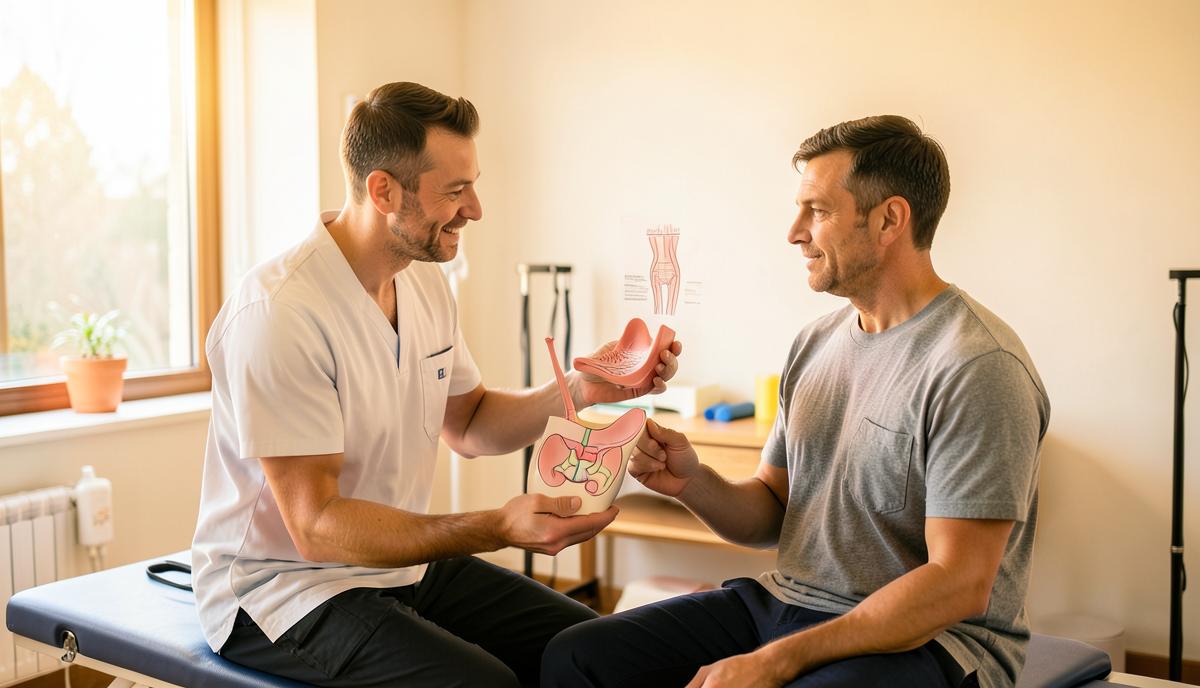
A pelvic-floor assessment can examine resting muscle activity, voluntary contraction, relaxation after contraction, endurance, tenderness, coordination, breathing, surrounding muscles and symptom reproduction.
EAU guidance specifically notes that pelvic-floor assessment in men may include trained rectal examination and that pelvic physiotherapists can assess pelvic-floor function.
A Simple Decision Framework
Use your dominant symptoms as a starting point, not a final diagnosis.
If your dominant symptom is:
- Leakage, especially after prostate surgery: weakness becomes more plausible. Read our weak pelvic floor guide.
- Pain or tension: overactivity deserves consideration. Read our tight pelvic floor guide.
- Both patterns: do not assume one internet exercise solves the problem. Read our pelvic floor dysfunction guide and consider professional assessment.
- Inability to relax the muscles: relaxation work may be more useful than adding repetitions. Try slow diaphragmatic breathing first.
When to See a Healthcare Professional
Seek assessment if you have persistent:
- Urinary leakage
- Difficulty urinating
- Pelvic pain
- Painful ejaculation
- Bowel-emptying problems
- Bowel leakage
- Symptoms that worsen with exercises
Seek urgent care for inability to urinate, significant bleeding, fever with severe urinary symptoms or sudden neurological loss of bladder or bowel control.
Frequently asked questions
Is a tight pelvic floor stronger than a weak pelvic floor?
Not necessarily. High resting tension is different from useful muscular strength.
Can Kegels make a tight pelvic floor worse?
Repeated contractions may be inappropriate when the primary problem is excessive tension or inability to relax, particularly if they aggravate symptoms.
Can a weak pelvic floor cause pain?
Pain is more commonly discussed in relation to overactivity and myofascial dysfunction, but symptoms are complex and weakness does not exclude another pain source.
Can you have tight and weak pelvic-floor muscles?
Yes. A muscle can be overactive and still lack useful strength or endurance.
What is the best way to know which one I have?
A pelvic-health assessment that evaluates both contraction and relaxation is more reliable than symptoms alone.
Train the muscle behind control
The Free Kegel Trainer guides you through squeeze and release intervals, day by day.
Start Day 1Sources
More Sexual Health articles
Medical disclaimer: This article is educational and not medical advice. Speak to a doctor or pelvic floor physiotherapist about persistent pelvic pain or urinary symptoms.